As you make your way to the grave of the Prophet ﷺ, realise that you are standing before the one whom Allah chose as a mercy to all the worlds. You are in the presence of the one chosen to spread divine guidance to every corner of the earth, spanning time and space, until it reached you.
You are standing in front of the one who sacrificed his life, his comfort, his wealth, and his safety, just so you could internalise the message of lā ilāha illā Allah.
As you stand there, know that you can never repay or fully acknowledge his efforts and sacrifices. Send your prayers and peace upon him and bear witness that he ﷺ did indeed convey the message and fulfil the trust until death came to him.
The One Who Endured Unimaginable Suffering for Your Sake
You stand before the one who was tortured and watched his Companions, such as Khabbāb and Bilāl (radiy Allāhu ʿanhum), being dragged across burning sand, their voices crying “Aḥad, Aḥad” through unbearable pain. He faced the brutality of the disbelievers with unwavering resolve.
In Ṭā’if, children hurled stones at him, wounding his blessed body until blood flowed from his feet. Yet he walked back to Makkah, praying for the guidance of those who had wronged him. When given the chance to see them crushed between two mountains, he chose mercy instead.
You stand before the one who endured hunger and hardship for days at a time. He organised armies and led his Companions in battle, standing closest to the enemy and never retreating. During the digging of the trench before the Battle of Khandaq, when his Companions tied stones to their stomachs to ease their hunger, he lifted his garment to reveal that he had bound two stones to his own.
The One Who Was the Best of Servants
You stand before the one who spent long hours in worship and intimate conversation with his Lord. He wept so intensely that the ground beneath him became wet with his tears. Even on the night before the Battle of Badr, while his Companions rested, he prayed beneath a tree and wept until dawn.
When ʿĀ’ishah once asked him, “Why do you do this, O Messenger of Allah, when Allah has forgiven your past and future sins?” he replied simply, “Should I not be a grateful servant?”
You stand before the one whom Allah offered a choice: to be a Prophet-King or a Prophet-Servant. He chose servitude. He lived simply, served his family, ate on the ground, mended his own clothes, and slept on a mat of palm fibres that left marks on his blessed back. Through his life, he taught his ummah what it truly means to live for Allah, not for the world.
The One Whose Love Was Felt by All
You stand before the one whose love was so deeply felt that each person around him believed themselves to be the most beloved to him. When asked whom he loved most, he replied without hesitation, “ʿĀ’ishah.” In a society where men scorned speaking openly of love for their wives, he broke the norms of ignorance and taught his Companions how to love for the sake of Allah.
Years after Khadījah passed away, he would weep at the sight of her necklace and say, “I was blessed with her love.”
He was the greatest father humanity has known, though he grew up without a father himself. When his daughter Fāṭimah entered his home, he would rise, take her hand, kiss her, and seat her in his own place. When his grandchildren climbed onto his back during prayer, he prolonged his prostration, allowing them to play undisturbed. This was the Messenger of Allah ﷺ.
The One Whose Compassion Knew No Bounds
You stand before the one whose compassion extended far beyond his family. He asked after Companions he had not seen for days, visited the sick in their homes, and comforted the broken-hearted. When a young servant girl asked him to walk with her through Madinah, he did so willingly, attending to her needs without hesitation. He recognised the worth of every human being.
When society shunned Julaybīb for his poverty and appearance, the Prophet himself found him a wife and declared, “He is from me, and I am from him.”
When a child lost his pet bird, he noticed and asked gently, “O ʿUmayr, what happened to your Nughayr?” His teaching was always wrapped in love. He said to Muʿādh, “By Allah, I love you. By Allah, I love you. Never forget to say at the end of every prayer: O Allah, help me to remember You, thank You, and worship You in the best way.”
The One Who Loved You Before You Were Born
His love was not limited to those who lived in his time. He spoke of you with longing, saying to his Companions, “How I wish I could meet my brothers and sisters, those who believed in me without seeing me.” You are the ones he yearned to meet.
You stand before the one who prayed for you in the depths of the night until his feet swelled with pain. On the Day of Judgement, he will stand before Allah and say, “Ummatī, ummatī.” He will intercede for you when no one else will.
You stand before Muḥammad ﷺ: the one who gave everything so that you might have everything.
Be a Respectful Visitor
The Prophet ﷺ once noticed that his Companion, Thābit ibn Qays (raḍiy Allāhu ʿanhu), was missing from the gathering. He turned to Saʿd ibn Muʿādh (raḍiy Allāhu ʿanhu) and asked, “O Abū ʿAmr, what’s the matter with Thābit? Is he ill?” Saʿd replied, “He is my neighbor, but I haven’t heard of any illness.” So Saʿd went to Thābit’s house and said: “The Prophet ﷺ noticed your absence.”
Thābit replied sadly, “When the verse was revealed ‘O you who believe, do not raise your voices above the voice of the Prophet…’ (49:2), I thought it was about me. My voice is louder than all of yours in his presence. Surely I must be one of the people of the Fire!” Saʿd returned and told the Prophet ﷺ what Thābit had said. The Prophet ﷺ replied: “No. Rather, he is among the people of Paradise.”
Such was the adab of the Companions; they feared disrespecting him even in the volume of their voices. Lower your voice in this sacred space. Do not harm a fellow believer by pushing or getting angry. Put away your phone. Be present. Be respectful. Follow the Sunnah and avoid innovations in acts of worship, no matter how beautiful or beneficial they may appear.
Know that he is aware of your presence and your visit. Your
greetings and prayers are conveyed to him. Picture his noble
form in your imagination, as though he is lying in his grave
before you, and hold his great status in your heart. It has
been narrated that the Prophet ﷺ said: “Allah has appointed
an angel at his grave who conveys the greetings of peace to him
from anyone who greets him from his ummah.” This applies
to those who are not present at his grave, so how much more
so for those who have traveled from distant lands, crossing
deserts, in longing to meet him, even though they could not
witness his radiant face.
The Prophet ﷺ also said: “Whoever sends blessings upon me
once, Allah will send blessings upon him ten times.” This is the
reward for praying for him with your tongue, so imagine the
reward for visiting him with your body. Then, go to the Prophet’s
pulpit and imagine the Prophet ﷺ ascending it, surrounded by
the Muhājirūn (emigrants) and Anṣār (helpers) as he delivered
his sermon, urging them to obey Allah. Ask Allah not to separate
you from him on the Day of Judgment. – Imām al-Ghazālī (raḥimahullāh)
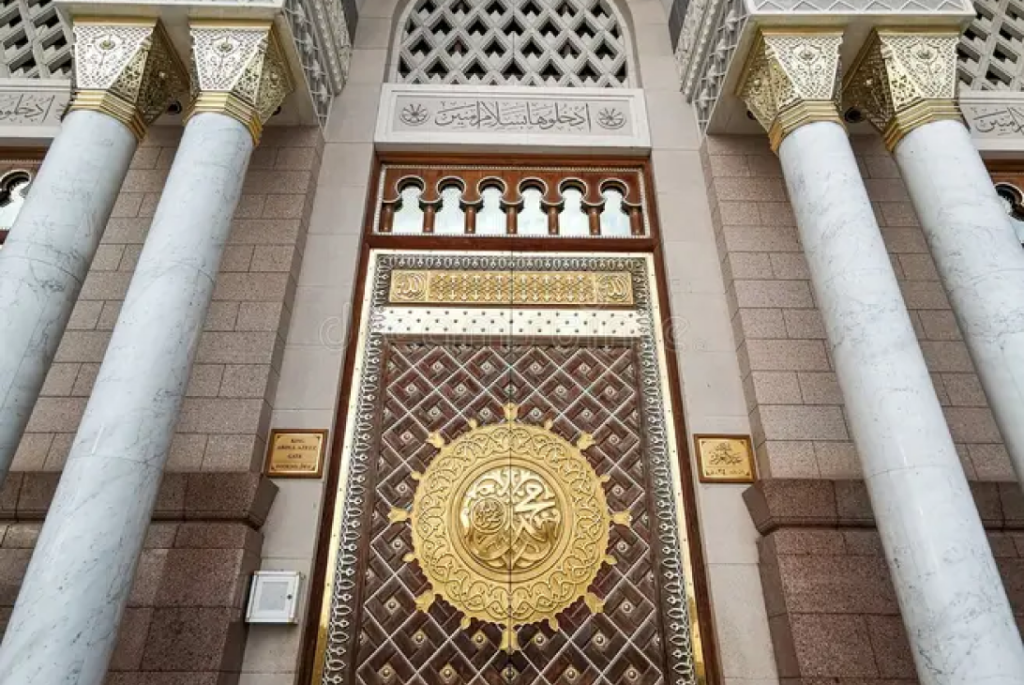 3. Entering the Masjid of the Prophet ﷺ