Have you ever wondered why Allah chose this specific sūrah from all the other sūrahs in the Qur’ān? Why are we required to read Sūrah al-Fātihah at least 17 times a day?
Why is it repeated in every single rakʿah? What’s so amazing about this sūrah?
Al-Fātiḥah means ‘the Opening’ as it opens the Qur’ān. It is the entrance for the Qur’ān and your ṣalāh; and your entry for attaining closeness to your Lord. Ṣūrah al-Fātiḥah is also known as the Mother of the Qur’ān, the Seven Oft-Repeated āyāt and the Cure. It is the greatest sūrah in the Qur’ān and the key to the entire Qur’ān. It is also both an introduction and a summary of the whole Qur’ān.
Al-Ḥasan (raḥimahullāh) said, “Allah sent down 104 books from the heavens and He condensed these books into four books: the Torah, the Zabūr, the Injīl and the Qur’ān. Then He condensed the content of the first three books into the Qur’ān. He then condensed the content of the Qur’ān into the Mufaṣṣal (Sūrahs 50-114). He then condensed the content of the Mufaṣṣal into Sūrah al-Fātiḥah.” Others added that that the content of Sūrah al-Fātiḥah can be condensed into the āyah: “You Alone we worship, and You Alone we ask for help.”
The 3 Key Themes
Sūrah al-Fātiḥah was revealed in Makkah. In keeping with the other Makkan sūrahs it focuses on the three fundamental principles:
1. Establishing the Oneness of Allah (ʿazza wa jall).
2. Establishing Prophethood.
3. Belief in the Hereafter.
Ṣūrah al-Fātiḥah: A Special Conversation
A distinctive quality that makes Ṣūrah al-Fātiḥāh extremely special is that it forms a unique conversation between you and Allah (ʿazza wa jall). Allah (ʿazza wa jall) responds to you after every āyah that you read in it.
Memorise the following ḥadīth, as it will transform your ṣalāh.
| You say: | Allah replies: |
|---|---|
اَلْحَمْدُ لِلّٰهِ رَبِّ الْعَالَمِيْنَ |
My slave has praised Me |
الرَّحْمٰنِ الرَّحِيْمِ |
My slave has extolled Me |
مٰلِكِ يَوْمِ الدِّينِ |
My slave has glorified Me (or My slave has entrusted his affairs to Me. |
إِيَّاكَ نَعْبُدُ وَإِيَّاكَ نَسْتَعِيْنُ |
This is between Me and My slave and My slave shall have what he asked for. |
اِهْدِنَا الصِّرَاطَ الْمُسْتَقِيْمَ ، صِرَاطَ الَّذِيْنَ أَنْعَمْتَ عَلَيْهِمْ غَيْرِ الْمَغْضُوْبِ عَلَيْهِمْ وَلَا الضَّآلِّيْنَ |
This is for My slave and My slave shall have what he asked for. |
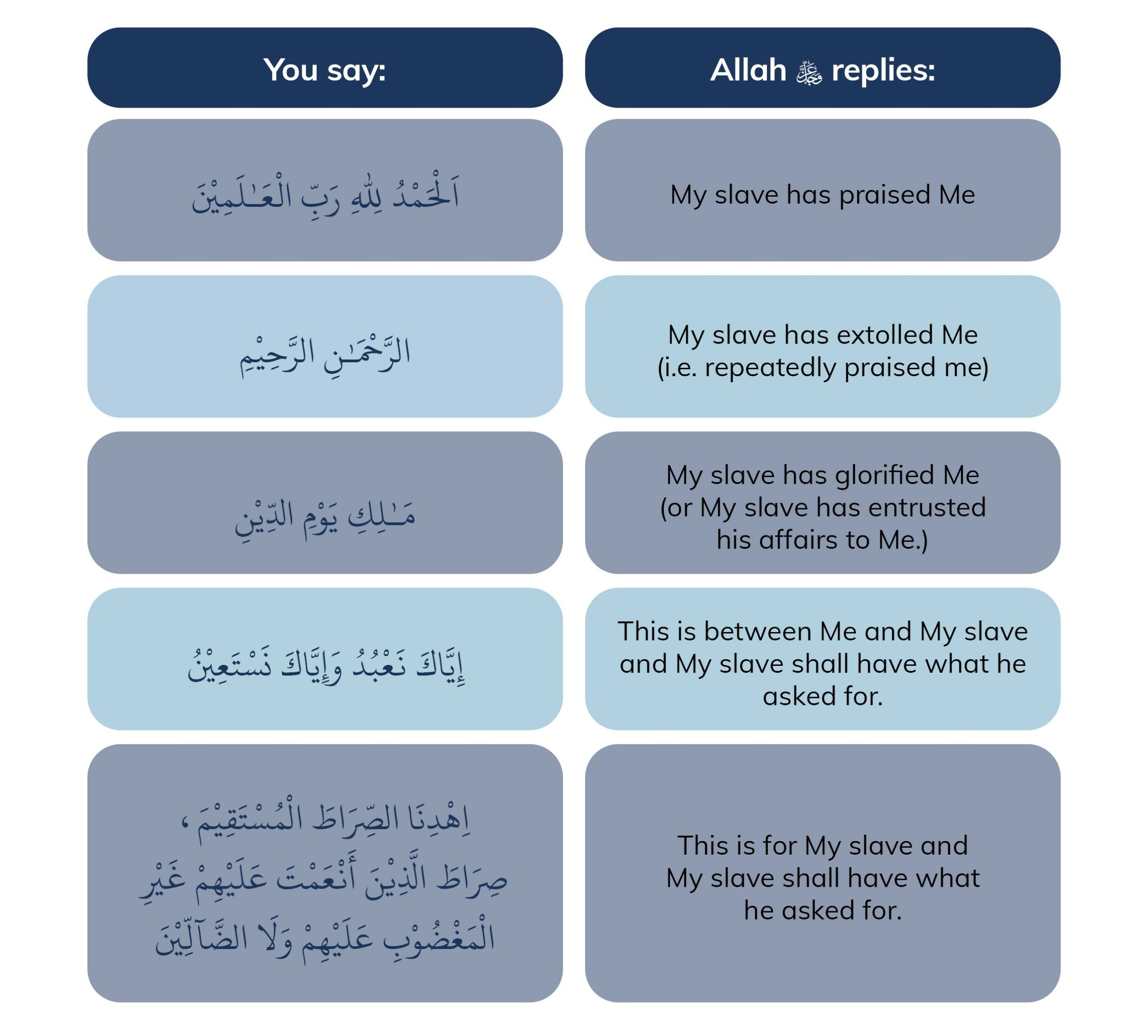
At the end of reading each āyah, pause like the Prophet ﷺ would when reciting al-Fātiḥah. Take a moment to reflect on Allah’s reply to you.
Reflect
On reading ‘My slave’ in the above hadith, what feeling does this invoke in you?
Think back to when you would visit your parents or grandparents, and they would affectionately say, ‘My child/son/daughter has come.’ How did this phrase make you feel?
Allah (ʿazza wa jall) is above all examples. He is the Most Powerful and the Lord of the worlds. Despite being an unworthy sinful slave of His, He still addresses you here as, ‘My slave.’
Ibn al-Qayyim (raḥimahullāh) said, “How extreme is the joy and happiness of the slave when his Lord says ‘My slave’ three times. By Allah, if the hearts were not clouded by the smoke of the desires and lusts, they would erupt from joy and delight when their Lord, Creator and God says, ‘My slave has praised Me, My slave has extolled me, My slave has glorified Me.’”
Sūrah al-Fātiḥah: The Best Duʿā’
Each time you recite Sūrah al-Fātiḥah, do you remember that it is a duʿā’?
Allah (ʿazza wa jall) taught us this perfect duʿā’ because of His endless Mercy. As humans, we continuously make mistakes and commit sins, and are in constant need of guidance. We need this guidance more than food and drink. By guiding us, Allah (ʿazza wa jall) helps us to obey Him and to stop sinning. Thus, no evil will befall us in this world nor the hereafter. For this reason, this sūrah is one of the most comprehensive duʿās.
The sūrah is also a lesson and a reminder on how to make duʿā’. Firstly, you ask Allah (ʿazza wa jall) through His Perfect Names, and, secondly, you express your servitude and need for Him. Sūrah al-Fātiḥah also reminds you of the importance of repetition and persistence when making duʿā’, as you make this duʿā’ at least 17 times every day.
Sūrah al-Fātiḥah reminds me…
- of who Allah (ʿazza wa jall) is
- to affirm the Oneness of Allah (ʿazza wa jall) and to strengthen my īmān in Him
- of the endless mercy & love of Allah (ʿazza wa jall)
- of my end and my ultimate destiny
- to not only contemplate deeply over Paradise and the love of Allah (ʿazza wa jall), but also to think about the Hell-fire and the fear of Allah (ʿazza wa jall)
- to praise Allah (ʿazza wa jall) with His Beautiful and Perfect Names
- of the importance of gratitude
- of my purpose in life, while also answering my questions of ‘Where did I come from?’ and ‘Where am I going?’
- of the most important relationship in my life: the slave-Master relationship
- to ask, trust, humble myself and worship Him Alone
- of who I should and should not aspire to be like
- of the importance of following the Sunnah of Allah’s Messenger ﷺ and of loving him
- not to become complacent and to always ask Allah (ʿazza wa jall) for guidance and firmness.
Āmīn
Remember to seal Sūrah al-Fātiḥah with Āmīn. The Messenger of Allah ﷺ said, “When the imām says Āmīn, then say Āmīn; for indeed the one whose Āmīn coincides with the Āmīn of the angels will have his previous sins forgiven” (Bukhārī).
Āmīn means, “O Allah, accept my duʿā.” ʿAlī (raḍiy Allāhu ʿanhu) said, “Āmīn is the seal of the Lord of the worlds. It is with it that His slaves seal their duʿā’.
Click here to read Tafsir Ṣūrah al-Fātiḥāh.