The Prophet ﷺ was the most God-fearing of men. He was the humblest and the most obedient to his Lord and had the purest soul. He was the best person to have ever worshipped, stood and prayed to his Creator. The highest level of khushūʿ any human being could possess was attained by him ﷺ. His lofty khushūʿ and softness of heart was a manifestation of his deep love, awe and veneration of Allah (ʿazza wa jall).
The ṣalāh of the Prophet ﷺ was the perfect embodiment of submission and humility, both internally and externally. Accordingly, it is vital that we educate ourselves about his ṣalāh and then try to emulate him.
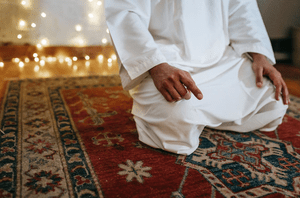
When standing up to pray, the Prophet’s head would be lowered. In sajdah, he would separate his arms from his body so widely that the whiteness of his armpits was visible. In the final tashahhud, his blessed gaze would not go beyond the finger he was pointing with. He would lengthen each pillar, praying with tranquility and calmness. Sometimes, even in congregational prayer, he would stand for so long after rukūʿ that his Companions (radiy Allāhu ʿanhum) would think he had forgotten. His private ṣalāh would be even lengthier. He would weep and pray for hours on end in the night.
ʿAbdullāh b. al-Shikh-khīr (raḍiy Allāhu ʿanhu) said, “I came to the Prophet ﷺ whilst he was praying. His inside was making a sound like the sound of the boiling of the cooking-pot [due to crying profusely]” (Nasā’ī). In another narration, the sound was likened to the noise of a mill-stone (Abū Dāwūd).
The Most Amazing Thing
ʿAṭā’ (raḥimahullāh) entered with ʿUbayd b. ʿUmayr (raḥimahullāh) upon ʿĀ’ishah (raḍiy Allāhu ʿanhā). When Ibn ʿUmayr asked ʿĀ’ishah (raḍiy Allāhu ʿanhā) to tell them about the most amazing thing which she had witnessed from the Messenger of Allah ﷺ, she cried.
She then said, “He got up one night and said, ‘O ʿĀ’ishah, leave me to worship my Lord.’ I told him, ‘By Allah, indeed I love to be with you, and I love what makes you happy.’ So he stood up, performed wuḍū and then stood to pray. He continued to cry until his lap became wet. He then cried and continued to cry until the ground became wet.
When Bilāl (raḍiy Allāhu ʿanhu) came to give the call to prayer and saw him crying, he said, ‘O Messenger of Allah ﷺ, are you crying when Allah has forgiven all your previous and upcoming sins?’ He replied, ‘Should I not be a grateful slave? Certain āyāt were revealed to me last night; woe to the one who recites them and does not ponder over what they contain (the last ten āyāt of Sūrah Āl ʿImrān, 3:190-200)’” (Ibn Ḥibbān).
Another moving ḥadīth relates how he ﷺ cried through the night in the Battle of Badr. ʿAli b. Abī Ṭālib (raḍiy Allāhu ʿanhu) said, “There wasn’t a horseman amongst us on the day of Badr except for Miqdād (raḍiy Allāhu ʿanhu). I observed that all of us were sleeping except the Messenger of Allah ﷺ who was under a tree, praying and crying until the morning” (Aḥmad).
An Incredible Account
The following ḥadīth is one of the most amazing accounts of the perfection and quality of the Prophet’s ﷺ ṣalāh:
Ḥudhayfah (raḍiy Allāhu ʿanhu) said, “I prayed with the Messenger of Allah ﷺ one night and he started reciting Sūrah al-Baqarah. I said to myself that he will do rukūʿ at the end of one hundred āyāt, but he carried on reciting. I then said to myself that he will perhaps recite the whole sūrah in a rakʿah, and he carried on reciting. (At the end of Sūrah al-Baqarah), I said to myself that he will (now) go into rukūʿ. However, he then started Sūrah al-Nisā’, and recited it. He then started Sūrah Āl ʿImrān and recited it slowly.
When he recited the āyāt which entailed the glorification of Allah (tasbīḥ), he glorified Him. When he recited the āyāt which entailed asking (duʿā’), he would ask Allah. And when he recited the āyāt which entailed the protection of Allah, he sought His protection.
He ﷺ then went into rukūʿ and said, ‘How Perfect is my Lord, the Magnificent.’ His bowing lasted about the same length of time as his standing. He then said, ‘May Allah respond to the one who has praised Him’, and he then stood for a long time, about the same length of time as he had spent in bowing. He then performed sajdah and said, ‘How Perfect is my Lord, the Most Exalted’, and his prostration lasted nearly the same length of time as his standing” (Muslim).
Allāhu Akbar! Go back and read this ḥadīth again to fully appreciate its significance. Can you imagine what the ṣalāh of Rasūlullāh ﷺ was like?
The above ḥadīth gives us a glimpse of the noble and pure love he ﷺ had for his Creator and Master (ʿazza wa jall). The Prophet ﷺ at the time was over the age of fifty. Despite this, along with the responsibilities he shouldered throughout the day, he still spent hours at night in standing, bowing and prostrating to his Lord.
ʿĀ’ishah (raḍiy Allāhu ʿanhā) narrated that the Prophet ﷺ used to pray (for so long) during the night that his feet would swell up. She asked him, “Why do you do this O Messenger of Allah when Allah has already forgiven your previous and upcoming sins?” He ﷺ replied, “Should I not be a thankful slave?” (Bukhārī)